I have personally practiced chakra meditation mantras for over five years and experienced profound shifts in energy, mental clarity, and spiritual awareness. What began as a simple daily practice evolved into a transformative path that deepened my connection to myself and the subtle energies governing life. This guide combines ancient wisdom with modern understanding, particularly drawing from Sri Amit Ray’s revolutionary 114 chakra system .
What Are Chakra Meditation Mantras?
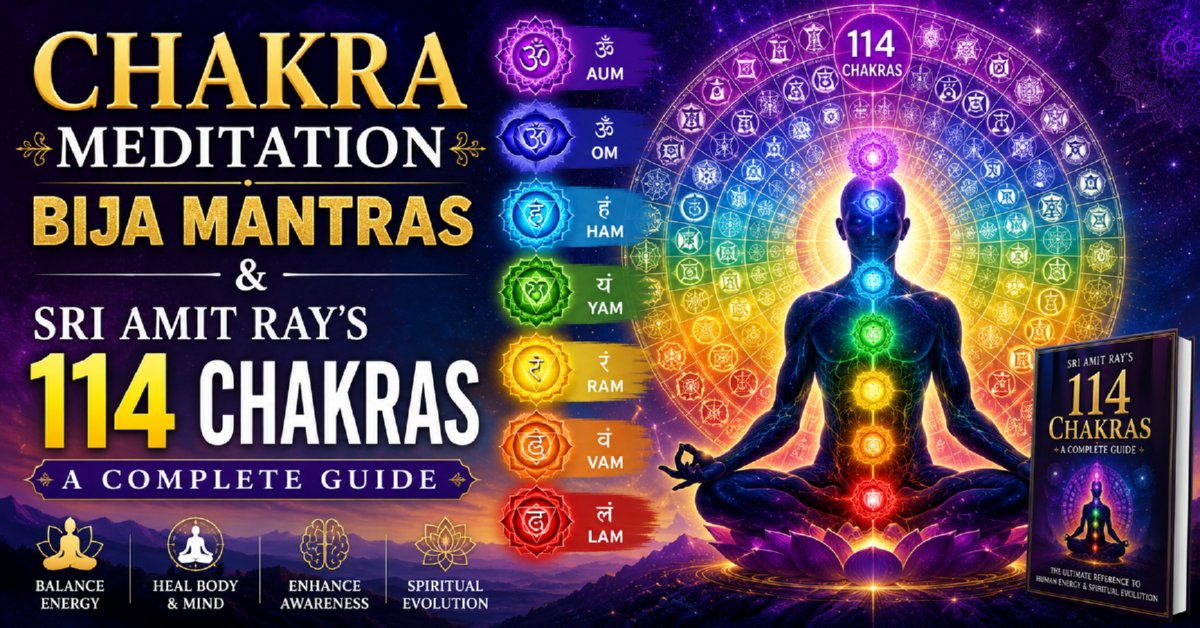
Chakra meditation mantras, also known as “Bija” seed mantras, are sacred, one-syllable sounds used to stimulate and balance the body’s energy centers. In the tradition of Sri Amit Ray, chakras are not physical things but divine intelligent conscious Agents. There are 114 specific Bija mantras for the 114 chakras, and also a global chakra unlocking mantra all are given by Guruji, Sri Amit Ray. The term “Bija” means “seed” in Sanskrit, symbolizing the potent energy contained within these simple yet powerful sounds. When chanted correctly, these mantras create specific vibrational frequencies that resonate with corresponding chakras, promoting healing, balance, and spiritual awakening. All 114 chakras are full with divine blessings only you need proper guidance to unlock them. Modern research observed mantra chanting heals and connects. Moreover Bija mantras like Om chanting removes negative thoughts.
These ancient sound formulas have been preserved through millennia of yogic tradition. Each mantra carries a unique energetic signature that activates dormant energy centers, clears blockages, and harmonizes the flow of prana (life force) throughout the subtle body. Unlike regular words, Bija mantras transcend linguistic meaning—their power lies in their vibrational quality rather than conceptual understanding.
Understanding Chakras: Beyond the Traditional Seven
In traditional yogic and tantric traditions, we often focus on the seven basic chakras aligned along the spine — from the root (Muladhara) at the base to the crown (Sahasrara) at the top of the head. These energy centers regulate physical, emotional, mental, and spiritual well-being. When balanced, they promote vitality, emotional stability, clear communication, intuition, and a sense of oneness. For me beyond the crown, the shiva-shakti mandala chakras are great.
Sri Amit Ray, through deep meditations in the Himalayas in 2005, revealed a far more comprehensive framework: the 114 chakra system. This system expands the traditional model significantly. According to his teachings:
- There are 108 chakras within the body and 6 outside the body (extending into the auric field and linked to higher cosmic consciousness).
- They break down into 7 basic chakras, 21 power chakras, and 86 master chakras.
- These are not just “wheels of energy” but intelligent, self-organizing neurobiological integration centers. They influence brain-body-behavior dynamics, immunity, emotions, cognition, and consciousness.
This expanded system offers a richer map for spiritual awakening, addressing subtle layers of energy that the seven-chakra model alone may not fully capture. It integrates ancient insights with modern perspectives on neuroscience, quantum biology, and holistic healing.
The Seven Primary Chakras and Their Bija Mantras
The classical yogic system recognizes seven primary energy centers aligned along the spinal column. Each chakra governs specific physical, emotional, and spiritual functions. Understanding these energy centers and their corresponding mantras is essential for effective chakra meditation practice.
| Chakra | Location | Bija Mantra | Primary Function |
|---|---|---|---|
| Muladhara (Root) | Base of spine | LAM | Grounding, survival, security |
| Svadhisthana (Sacral) | Lower abdomen | VAM | Creativity, sexuality, emotions |
| Manipura (Solar Plexus) | Upper abdomen | RAM | Personal power, confidence, will |
| Anahata (Heart) | Center of chest | YAM | Love, compassion, connection |
| Vishuddha (Throat) | Throat | HAM | Communication, truth, expression |
| Ajna (Third Eye) | Between eyebrows | OM (AUM) | Intuition, insight, wisdom |
| Sahasrara (Crown) | Top of head | Silence or OM | Spiritual connection, enlightenment |
Sri Amit Ray’s Revolutionary 114 Chakra System
While the traditional seven-chakra system has served practitioners for centuries, Sri Amit Ray revealed a comprehensive understanding of 114 chakras during deep nirvikalpa samadhi in 2005. This revelation expanded the energetic map of human consciousness far beyond conventional understanding, offering unprecedented precision for healing and spiritual development.
The 2005 Revelation in Nirvikalpa Samadhi
Nirvikalpa samadhi represents the highest state of meditative absorption—a condition of complete consciousness beyond thought, sensation, and ego-identification. During this profound state in 2005, Sri Amit Ray directly perceived the intricate network of 114 chakras that constitute the complete subtle energy anatomy of human beings.
This wasn’t theoretical speculation or intellectual construction, but direct experiential knowledge obtained in the deepest states of consciousness. The precision and detail of this system reflects the clarity of perception available only in such exalted states of awareness.
Foundational Texts of the 114 Chakra System
“The Secrets of the 114 Chakras” (2005) is the foundational text where Sri Amit Ray first unveiled the 114 chakra system to the world. This landmark book delves into the spiritual, subtle energy anatomical, and quantum dimensions of the chakras, providing comprehensive understanding that bridges ancient wisdom with modern scientific perspectives.
The book explores not only the locations and functions of these 114 energy centers but also their interconnections, resonance patterns, and relationships to states of consciousness. It represents a quantum leap in understanding human energy systems.
“Ray 114 Chakra System: Names, Locations and Functions” (2020) is a definitive practical guide for healing, mapping out the chakras with precision. This comprehensive manual provides practitioners, healers, and serious spiritual seekers with exact locations, Sanskrit names, functional descriptions, and meditation techniques for working with all 114 chakras.
For those interested in the philosophical and spiritual foundations, “The Bhagavad Gita and Sri Amit Ray’s 114 Chakra System” brilliantly integrates timeless wisdom from the Bhagavad Gita with the practical application of the expanded chakra system.
Beyond the Traditional Seven: Understanding the Complete System
The 114 chakra system includes the classical seven major chakras but extends far beyond them. These additional energy centers are located throughout the physical and subtle bodies, including:
- 7 Basic chakras: The well-known seven elementary energy centers
- Power chakras: Smaller vortexes at joints, organs, and specific anatomical locations
- Master chakras: Subtle energy points with specific functions in consciousness development
- Inter-dimensional chakras: Energy centers connecting different layers of consciousness and reality
This comprehensive system provides a complete map for understanding the full spectrum of human energy, from gross physical vitality to the subtlest dimensions of spiritual consciousness. Working with the expanded system allows for more precise healing, targeted spiritual development, and deeper understanding of consciousness itself.
How to Chant and Meditate with Bija Mantras
The effectiveness of Bija mantra meditation depends significantly on proper technique. Sound vibration works through resonance—when executed correctly, the mantra creates specific frequencies that harmonize with the target chakra, catalyzing profound energetic shifts.
Step-by-Step Practice Guide
- Prepare Your Space and Posture: Find a quiet location where you won’t be disturbed. Sit with your spine straight, shoulders relaxed, and palms resting on your knees (either facing up to receive energy or down to ground). You may sit cross-legged on the floor, in a chair with feet flat, or in any comfortable meditation posture that maintains spinal alignment.
- Center Yourself: Take several deep, slow breaths to settle your mind and body. Release tension with each exhale. Allow your breathing to find its natural rhythm without forcing.
- Focus Your Awareness: Bring your attention to the physical location of the chakra you want to balance. Visualize this area, feel into it with your inner awareness, and notice any sensations present—warmth, coolness, tightness, openness, or simply neutral presence.
- Chant the Mantra: Take a deep breath in, and on the exhale, audibly vibrate the mantra. Prolong the sound (e.g., “L-a-a-a-a-m”) so you feel the resonance vibrating in that specific area of your body. The vibration itself is the healing mechanism—allow it to penetrate deeply.
- Feel the Vibration: As you chant, pay attention to where you feel the sound resonating. For lower chakras, you should feel vibration in the corresponding physical locations. For higher chakras, the resonance may be felt more subtly in the head or experienced as energetic sensations.
- Follow a Routine: You can focus on a single chakra during a short session (5-10 minutes for beginners), or cycle through all seven in order from the Root up to the Crown. Consistency matters more than duration—daily practice of even 10 minutes produces better results than occasional longer sessions.
Profound Shifts I’ve Experienced
After five years, the cumulative effects have been remarkable and multifaceted:
- Energy and Physical Vitality: I feel a much stronger, more stable life force. Old fatigue patterns dissolved, and my body feels more resilient. Many minor health issues improved as energy blockages cleared across the wider chakra network.
- Mental Clarity and Focus: The practice sharpened my concentration dramatically. Activating the higher head and brain-related chakras (part of the 114) enhanced memory, creativity, and decision-making. Negative thought loops reduced significantly.
- Emotional Healing and Balance: Deep layers of emotional conditioning surfaced and released — especially through heart and solar plexus clusters. I developed greater compassion, reduced reactivity, and a stable inner peace that persists even in challenging situations.
- Spiritual Awareness: This is where the practice truly shines. I’ve experienced expanded states of consciousness, stronger intuition, vivid meditative insights, and a profound sense of interconnectedness. Moments of non-local awareness and deep stillness became more accessible. Many practitioners, including myself, describe feeling “blissful,” “complete,” and aligned with higher purpose.
- Synchronicities and Flow: Life began to feel more guided. Opportunities, healing connections, and inner guidance appeared more naturally.
Lessons Learned
The journey wasn’t always easy. In the first year, activating subtler chakras sometimes brought up intense emotional joy, or physical sensations (known as “energy releases”). Patience and proper grounding were essential. Consistency mattered more than intensity — slow, sincere daily practice yielded the best long-term results.
The beauty of Sri Amit Ray’s 114 chakra system lies in its precision and depth. It bridges ancient wisdom with modern insights into consciousness and the body-mind connection. The specific mantras act like keys that unlock finer layers of our being
I also learned the importance of integrating ethics (Yama-Niyama), diet, and lifestyle. The 114 system works best as a holistic life style, and healing path, not just a meditation technique.
Advanced Techniques for Experienced Practitioners
Once you’ve established comfort with the basic seven-chakra practice, you can explore more advanced approaches:
- Silent Mental Chanting: After developing facility with audible chanting, practice repeating the mantras silently in your mind while maintaining awareness of the vibration. This internalized practice can be performed anywhere, anytime.
- Coordinated Breathwork: Synchronize specific breathing patterns (pranayama) with mantra repetition for amplified effects.
- Visualization Integration: Combine mantra chanting with visualizations of colors, symbols, or light associated with each chakra.
- Working with the 114 Chakra System: As you advance, incorporate Sri Amit Ray’s expanded system, using specialized mantras and techniques for specific minor and micro chakras according to your developmental needs.
Specific Meditation Techniques for Each Chakra
While the general approach to Bija mantra meditation remains consistent, each chakra responds to subtle variations in technique, visualization, and intention. Scientists have done considerable of research on mantras effect on our brain. Gamma brainwaves are the higher brain waves, present during states of intense learning, and 40 Hz gamma brain waves mantra chanting activates the 12 brain chakras. Gamma waves vibrations is also effective for the spinal energy centers [2].
Here are specific practices I’ve found most effective for each energy center:
Muladhara (Root Chakra) – LAM
Technique: Sit in a grounded position with your sitting bones firmly connected to the earth. As you chant “LAM,” visualize deep red light at the base of your spine. Imagine roots extending from your body deep into the earth, drawing up stabilizing energy.
Duration: 5-7 minutes
Best for: Anxiety, insecurity, financial stress, feeling ungrounded
Svadhisthana (Sacral Chakra) – VAM
Technique: Focus on your lower abdomen, about two inches below the navel. Chant “VAM” while visualizing flowing orange light like water. Allow creative energy and emotional flow to move freely without resistance.
Duration: 5-7 minutes
Best for: Creative blocks, emotional numbness, relationship issues, low libido
Manipura (Solar Plexus Chakra) – RAM
Technique: Bring awareness to your upper abdomen. As you chant “RAM,” visualize bright yellow sunlight radiating from your solar plexus. Feel your personal power, will, and confidence expanding with each repetition.
Duration: 5-7 minutes
Best for: Low self-esteem, lack of direction, difficulty setting boundaries, digestive issues
Anahata (Heart Chakra) – YAM
Technique: Place your awareness in the center of your chest. Chant “YAM” with a gentle, loving quality. Visualize emerald green or soft pink light. As you practice, cultivate feelings of compassion first toward yourself, then extending to others.
Duration: 7-10 minutes
Best for: Difficulty giving or receiving love, grudges, loneliness, cardiovascular issues
Vishuddha (Throat Chakra) – HAM
Technique: Focus on your throat area. The “HAM” mantra naturally resonates here. Visualize sky-blue light. As you chant, imagine your authentic voice becoming clearer, more confident, and more truthful with each vibration.
Duration: 5-7 minutes
Best for: Fear of speaking up, difficulty expressing feelings, throat problems, dishonesty
Ajna (Third Eye Chakra) – OM
Technique: Direct your attention to the point between your eyebrows. Chant “OM” (pronounced AUM), feeling the vibration in your forehead and throughout your skull. Visualize indigo or deep purple light. Open yourself to intuitive insights and inner knowing.
Duration: 7-10 minutes
Best for: Confusion, lack of clarity, disconnection from intuition, headaches
Sahasrara (Crown Chakra) – Silence or OM
Technique: Bring awareness to the top of your head. You may chant “OM” very softly or simply rest in silence. Visualize violet or white light. Surrender to the experience of pure consciousness beyond individual identity.
Duration: 10-15 minutes
Best for: Spiritual disconnection, existential confusion, attachment to material reality
For those working with Sri Amit Ray’s 114 chakra system, these seven traditional practices form the foundation. Advanced practitioners can then incorporate specialized techniques for the additional 107 chakras as described in Ray’s comprehensive guides.
Practical Applications: Healing and Transformation
The true value of chakra meditation mantras lies not in theoretical knowledge but in practical application. From my own experience and observation of hundreds of practitioners, the benefits manifest across physical, emotional, mental, and spiritual dimensions.
Physical Healing Benefits
While chakra meditation should never replace medical treatment, consistent practice supports overall health and wellbeing:
- Stress reduction: Regular practice activates the parasympathetic nervous system, reducing cortisol and promoting relaxation
- Improved sleep: Particularly through Crown and Third Eye chakra work
- Enhanced vitality: Balanced energy flow increases overall life force
- Pain management: Focused awareness and energy work can reduce chronic pain
- Immune support: Stress reduction and energy balance support immune function
Emotional and Mental Benefits
The emotional transformation through chakra work often proves most dramatic:
- Emotional regulation: Better capacity to process and integrate difficult emotions
- Reduced anxiety: Particularly through Root and Heart chakra practices
- Enhanced confidence: Solar Plexus work directly addresses self-esteem
- Improved relationships: Heart and Sacral chakra balance enhances connection
- Mental clarity: Third Eye activation supports decision-making and insight
Spiritual Development
For those on a spiritual path, chakra meditation provides a systematic approach to awakening:
- Expanded consciousness: Progressive opening of energy centers elevates awareness
- Intuitive development: Third Eye activation enhances psychic sensitivity
- Spiritual connection: Crown chakra work deepens relationship with the transcendent
- Kundalini activation: Systematic chakra work prepares the energy body for kundalini awakening
- Self-realization: Ultimate goal of recognizing one’s true nature beyond ego-identification
Integrating the 114 Chakra System for Advanced Healing
The expanded understanding provided by Sri Amit Ray’s 114 chakra system allows for unprecedented precision in healing work. Rather than addressing only broad energy centers, practitioners can identify and work with specific subtle points related to particular issues:
- Specific phobias or traumas held in micro chakras
- Organ-specific healing through associated minor chakras
- Relationship patterns stored in interpersonal chakras
- Karmic patterns held in trans-dimensional chakras
- Cognitive patterns and mental constructs in specialized head chakras
This level of specificity transforms healing from a general wellness practice into a precise therapeutic intervention.
Common Mistakes to Avoid
Through years of personal practice and teaching others, I’ve identified several common pitfalls that reduce effectiveness or create unnecessary frustration:
1. Incorrect Pronunciation
The power of Bija mantras lies in their specific vibrational quality. Mispronunciation changes the frequency and reduces effectiveness. Listen to authentic recordings from qualified teachers to ensure accurate pronunciation. The final “M” in most mantras should be pronounced as a humming sound, not a hard stop.
2. Rushing the Practice
Many beginners try to move through all seven chakras too quickly, spending only 30 seconds on each. This doesn’t allow sufficient time for the vibration to penetrate and create change. Quality always trumps quantity—better to work deeply with one or two chakras than superficially rush through all seven.
3. Inconsistent Practice
Practicing intensively for a week then abandoning the practice for a month produces minimal results. Consistency matters more than duration. Even 10 minutes daily outperforms 90-minute sessions done sporadically.
4. Excessive Mental Strain
Some practitioners create tension through excessive concentration, trying to “force” the chakras to activate. The practice should feel effortless despite being focused. Think of it as gentle invitation rather than forceful demand.
5. Neglecting Physical Grounding
Working exclusively with upper chakras while neglecting lower ones creates imbalance—spacey, ungrounded states that feel spiritual but lack practical integration. Always ensure your Root chakra remains balanced as the foundation for all higher development.
6. Ignoring Integration Time
After completing your practice, sit quietly for 2-3 minutes before jumping into activity. This integration period allows the energetic shifts to settle and stabilize.
Scientific Perspective on Sound Vibration and Energy Centers
While traditional chakra systems emerged from ancient yogic knowledge, modern science increasingly validates the fundamental principles underlying these practices. Understanding the scientific mechanisms enhances appreciation and effective application.
Cymatics: The Science of Sound Vibration
Cymatics demonstrates how sound frequencies create geometric patterns in matter. Different frequencies produce different patterns—a physical demonstration of how sound vibration organizes energy and substance. When we chant Bija mantras, we’re creating specific vibrational patterns that influence our physical and subtle bodies according to the same principles.
Biofield Science
Emerging research in biofield science confirms the existence of measurable electromagnetic fields around the human body. These fields correspond closely to traditional chakra locations. Practitioners and researchers have documented changes in biofield measurements following energy healing practices, including chakra meditation.
Neurological Effects of Chanting
Brain imaging studies demonstrate that chanting and mantra meditation produce measurable changes in brain activity:
- Increased activity in prefrontal cortex (associated with focus and awareness)
- Reduced activity in amygdala (fear and stress center)
- Enhanced coherence between brain hemispheres
- Increased production of beneficial neurotransmitters (serotonin, dopamine, endorphins)
- Activation of vagus nerve, promoting parasympathetic nervous system activation
Quantum Perspectives
Sri Amit Ray’s writings on the 114 chakra system frequently reference quantum dimensions of consciousness and energy. Quantum physics reveals a universe of vibrational fields and non-local consciousness that aligns remarkably with ancient descriptions of subtle energy anatomy. While more research is needed, the parallels between quantum mechanics and yogic philosophy continue to intrigue scientists and practitioners alike.
Frequently Asked Questions (FAQ)
What is the best time of day to practice chakra meditation mantras?
Early morning (between 4-6 AM, known as Brahma Muhurta in yogic tradition) is considered ideal because the mind is naturally quieter and the atmosphere more peaceful. However, consistency matters more than timing—practice when you can maintain a regular schedule. Many practitioners also benefit from evening sessions to release the day’s accumulated stress. Avoid practicing immediately after heavy meals.
How long should I practice before seeing results?
Most practitioners notice subtle shifts within 1-2 weeks of consistent daily practice—improved mood, better sleep, or reduced anxiety. More substantial transformations typically emerge after 6-8 weeks of regular practice. However, benefits accumulate progressively over months and years. Think of chakra meditation as a lifelong practice rather than a quick fix.
Can I practice chakra mantras if I belong to a different religious tradition?
Absolutely. While these practices emerged from Hindu and Buddhist traditions, the underlying principles of energy and vibration are universal. Many Christians, Jews, Muslims, and practitioners of other faiths incorporate chakra work into their spiritual lives without conflict. The mantras are sounds that create specific vibrations—they don’t require belief in any particular theology.
What’s the difference between the 7-chakra and 114-chakra systems?
The traditional seven-chakra system identifies the major energy centers along the central channel of the body. Sri Amit Ray’s 114 chakra system expands this understanding to include 114 distinct energy centers throughout the physical and subtle bodies. The seven major chakras remain foundational, but the complete system provides much greater precision for healing, spiritual development, and understanding consciousness. Beginners should start with the seven primary chakras before exploring the expanded system.
Should I chant out loud or silently?
Both approaches have value. Audible chanting is generally recommended for beginners because it’s easier to maintain focus and you can feel the physical vibration more clearly. As you develop proficiency, silent mental chanting becomes equally effective and can be practiced anywhere, anytime. Many experienced practitioners use audible chanting for formal meditation sessions and silent chanting throughout the day as needed.
Can chakra meditation help with physical health conditions?
While chakra meditation supports overall health and wellbeing, it should complement rather than replace medical treatment for specific health conditions. Research demonstrates benefits for stress-related conditions, chronic pain, anxiety, depression, and immune function. Always consult with qualified healthcare providers for medical issues while using chakra practices as supportive adjunct therapy.
How do I know which chakra needs balancing?
Pay attention to your life circumstances and symptoms. Physical issues often correlate with specific chakras (for example, throat problems with Throat chakra, digestive issues with Solar Plexus). Emotional patterns also provide clues: fear and insecurity suggest Root chakra imbalance, difficulty expressing yourself indicates Throat chakra issues, lack of confidence points to Solar Plexus. When in doubt, work systematically through all seven chakras in sequence from Root to Crown.
Is it safe to practice chakra meditation without a teacher?
Basic chakra meditation practices are generally safe for self-practice, particularly when starting with the traditional seven chakras. However, working with a qualified teacher provides personalized guidance, corrects errors, and helps navigate challenges that arise. For advanced practices, healing work, kundalini work, or intensive work with the 114 chakra system, guidance from an experienced teacher is strongly recommended.
What should I do if I feel uncomfortable sensations during practice?
Mild warmth, tingling, or gentle energy movement is normal and indicates the practice is working. If you experience pain, dizziness, extreme emotional distress, or other concerning symptoms, stop the practice and return to normal breathing. Ground yourself by focusing on your Root chakra and physical body. If symptoms persist, consult with an experienced meditation teacher or healthcare provider. Sometimes discomfort indicates energetic release, but discernment is important.
Can children practice chakra meditation mantras?
Yes, simplified chakra practices can benefit children, particularly for emotional regulation, focus, and stress management. Keep sessions short (5-10 minutes), make it playful rather than rigid, and focus on simple visualization and gentle chanting. Children often respond especially well to color visualization associated with each chakra. Supervise practice and ensure it feels enjoyable rather than forced.
Conclusion: Your Journey with Chakra Meditation Mantras
Chakra meditation mantras represent one of humanity’s most powerful tools for self-transformation, healing, and spiritual awakening. These ancient Bija seed sounds—LAM, VAM, RAM, YAM, HAM, OM—carry vibrational frequencies that directly influence your energy body, emotional state, mental clarity, and spiritual consciousness.
The traditional seven-chakra system provides an accessible entry point for beginning practitioners, offering a clear map for working with your primary energy centers. As you develop proficiency, Sri Amit Ray’s revolutionary 114 chakra system opens vast horizons for deeper work, precise healing, and advanced spiritual development.
The key to success lies not in accumulating theoretical knowledge but in consistent, dedicated practice. Start where you are, work with what resonates, and trust the process. Even 10 minutes of daily practice produces profound cumulative benefits over weeks, months, and years.
Remember the fundamental approach: sit with proper posture, focus your awareness on the target chakra, breathe deeply, and vibrate the corresponding mantra with full presence. Feel the vibration, observe the effects, and remain consistent. Whether you work with a single chakra or cycle through all seven, the practice itself becomes your teacher.
As someone who has experienced dramatic life transformation through these practices—from chronic anxiety to consistent peace, from disconnection to spiritual purpose, from confusion to clarity—I can attest to the authentic power of chakra meditation mantras. This is not theoretical philosophy but practical technology for consciousness transformation.
Your energy body is waiting to be awakened. Your chakras contain vast potential for healing, growth, and realization. The mantras provide the key. All that remains is your commitment to regular practice.
Begin today. Choose one chakra that calls to you, learn its Bija mantra, and practice for 10 minutes. Notice what shifts. Trust the ancient wisdom encoded in these sacred sounds. Your journey toward balance, healing, and awakening has already begun.
Key References and Further Reading
- Ray, Amit. The Secrets of the 114 Chakras (2005) – Foundational text revealing the complete chakra system
- Ray, Amit. Ray 114 Chakra System: Names, Locations and Functions (2020) – Practical guide with precise chakra mapping
- Ray, Amit. The Bhagavad Gita and Sri Amit Ray’s 114 Chakra System (2015) – Integration of classical wisdom with expanded chakra understanding
- Traditional Vedic texts on chakra systems and sound vibration
- Modern scientific research on biofield science, cymatics, and consciousness studies