पार्वती बोली शंकर से
Parvati Boli Shankar Se – A Divine Conversation of Eternal Love
“पार्वती बोली शंकर से” (Parvati boli Shankar se) is one of the most beloved modern Shiv-Parvati bhajans that has touched millions of hearts. Sung soulfully by Hansraj Raghuwanshi, this composition beautifully portrays the intimate and eternal dialogue between Goddess Parvati and Lord Shiva (Bholenath).
Released in February 2022 under Nav Records, the song quickly became a favourite among devotees, especially during Mahashivratri, Sawan, and other auspicious occasions dedicated to Lord Shiva. Similar song: Jab Zid Pe Aa Gayi Parvati is anpther popular Hindi language song and is sung by Sadhu Tiwari. Parvati, from the album Hanuman Ansh cinema was released in the year 2026.
📜 About the Bhajan
The title itself means “Parvati said to Shankar”. It is not merely a song of devotion; it is a poetic re-enactment of the divine love story of Shiva and Parvati — a relationship that transcends time, space, and countless births.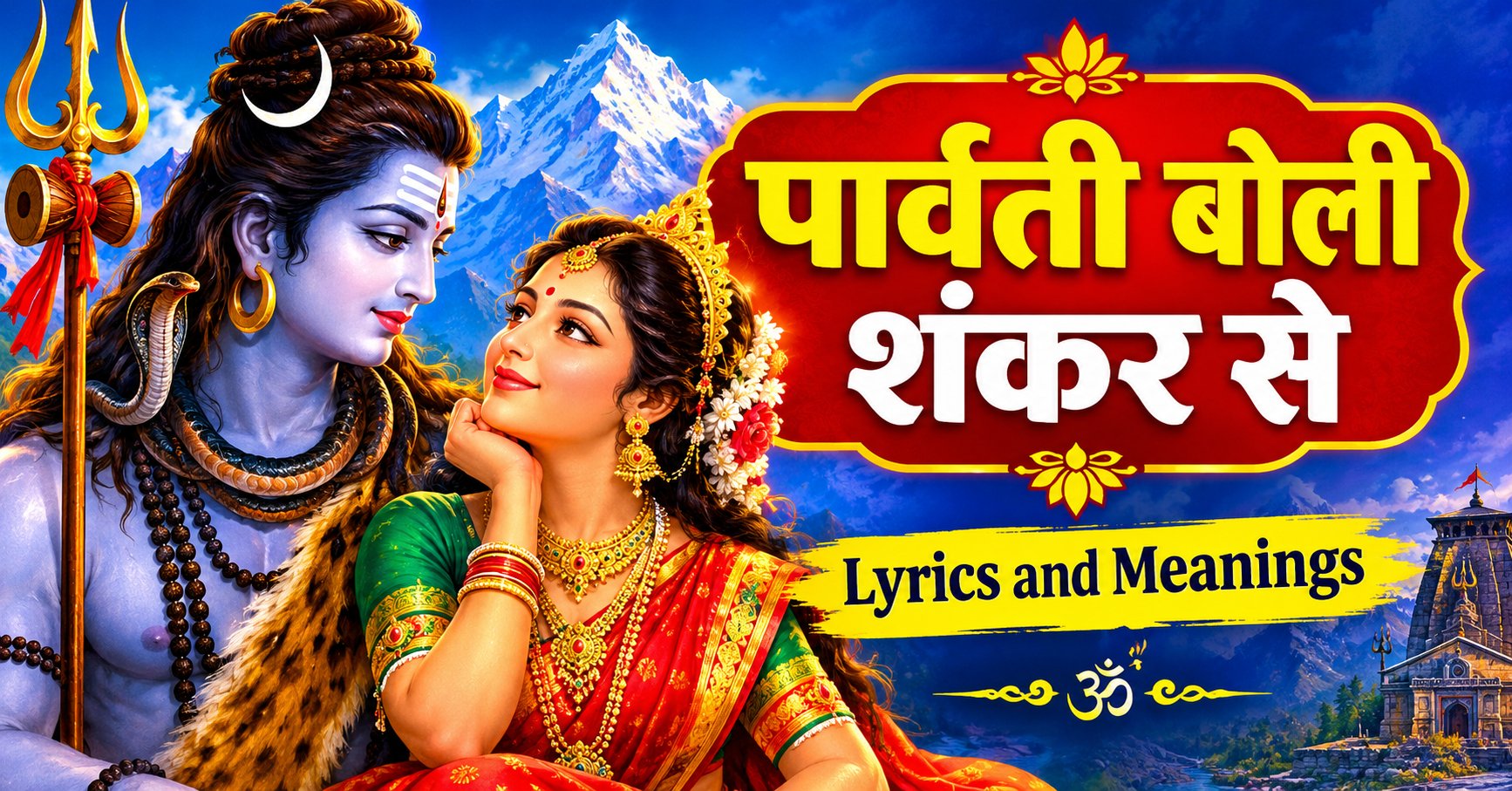
In this bhajan, Parvati lovingly requests Lord Shiva to remain with her in every lifetime, never to let go of her hand. Lord Shiva, in turn, responds with the same eternal commitment. The lyrics capture both the tenderness of their relationship and the profound spiritual truth of Shiva-Shakti being inseparable.
The Dialogue of Shiva & Parvati
In Hindu Puranic tradition, Lord Hanuman is revered as the 11th Rudra avatar (a partial manifestation / Ansh) of Lord Shiva. His birth originates from a divine exchange between Lord Shiva and Goddess Parvati during the Treta Yuga:
Goddess Parvati: “O Mahadev, when Lord Vishnu incarnates on Earth as Rama, you desire to serve Him. If you leave Kailash, how shall I remain here without you?“
Lord Shiva: “Devi, I shall not leave Kailash entirely. Instead, I will manifest a portion of my divine energy (Tejas)—my 11th Rudra energy—in a monkey form on Earth to assist Rama.”
Through the guidance of the Saptarshis, this divine energy was placed into Mata Anjana’s womb, giving birth to Lord Hanuman. Consequently, scriptures refer to Hanuman Ji as Rudravatar, Shankar Suvan, and Shiv-Ansh.
📖 Line-by-Line Lyrics with Meanings
Below is a detailed table presenting each major lyric line along with its English meaning and spiritual interpretation:
| Lyric Line (Hindi / Roman) | Meaning & Interpretation |
|---|---|
| पार्वती बोली शंकर से Parvati boli Shankar se |
Parvati spoke to Shankar (Lord Shiva). The song begins by setting the scene of a loving conversation between the Divine Mother and the Supreme Lord. |
| सुनिये भोलेनाथ जी Suniye Bholenath ji |
Please listen, O Bholenath (the Innocent Lord). Parvati affectionately addresses Shiva by his popular name that reflects his simple and pure nature. |
| रहना है हर एक जन्म में मुझे तुम्हारे साथ जी Rehna hai har ek janam mein Mujhe tumhare saath ji |
I want to stay with you in every birth. This expresses the soul’s deepest desire for eternal companionship with the Divine across all lifetimes. |
| वचन दीजिये ना छोड़ेंगे कभी हमारा हाथ जी Vachan dijiye naa chhodenge Kabhi hamara haath ji |
Please give me your word that you will never let go of my hand. A sacred vow of eternal protection and togetherness is sought. |
| ओ भोलेनाथ जी ओ शम्भू नाथ जी ओ भोलेनाथ जी ओ शंकर नाथ जी Oh Bholenath ji oh Shambhu Nath ji Oh Bholenath ji oh Shankar Nath ji |
O Bholenath! O Shambhunath! O Shankarnath! Loving invocations using different names of Lord Shiva, each highlighting a different aspect of his divinity. |
| जैसे मस्तक पे चंदा है गंगा बसी जटाओं में Jaise mastak pe chanda hai Ganga basi jataon mein |
Just as the moon rests on your forehead and the sacred Ganga resides in your matted locks… These are iconic symbols of Shiva’s serene and purifying presence. |
| वैसे रखना हे अविनाशी मुझे प्रेम की छाँव में Waise rakhna he abhinashi Mujhe prem ki chhaon mein |
In the same way, O Imperishable One, keep me under the shade of your love. Parvati asks to be permanently sheltered in Shiva’s divine love, just as the moon and Ganga are forever with him. |
| कोई नहीं तुमसा तीनों लोकों में दसों दिशाओं में Koi nahi tumsa teeno lokon mein Dasho dishaon mein |
There is no one like you in the three worlds (heaven, earth, underworld) or in the ten directions. An expression of Shiva’s unmatched supremacy and uniqueness. |
| महलों से ज्यादा सुख है कैलाश की खुली हवाओं में Mehlon se jyada sukh hai Kailash ki khuli hawaon mein |
There is more happiness in the open winds of Kailash than in any palace. True joy lies in the spiritual abode of Shiva rather than material luxury. |
| तुम हो जहाँ वहाँ होती है अमृत की बरसात जी Tum ho jahan wahan hoti hai Amrit ki barsaat ji |
Wherever you are, there is a shower of nectar (amrit). Shiva’s presence itself is the source of immortality and divine bliss. |
| देव हो तुम देवों के भोले अमर हो अंतर्यामी हो Dev ho tum devon ke bhole Amar ho antaryami ho |
You are the God of gods, the innocent one; you are immortal and the inner knower of all hearts. Praise of Shiva as the supreme, eternal, and omniscient deity. |
| भाग्यवान हैं हम त्रिपुरारी आप हमारे स्वामी हो Bhagyawan hain ham Tripurari Aap hamare swami ho |
We are truly fortunate, O Tripurari (destroyer of the three cities); you are our Lord and Master. Acknowledgement of divine grace and complete surrender. |
| पुष्प विमानों से प्यारी हमको नंदी की सवारी जी Pushp vimanon se pyari Hamko Nandi ki sawari ji |
More beloved than flower-adorned celestial chariots is the ride on Nandi (Shiva’s bull). Preference for simple, pure devotion over grand material displays. |
| युगों युगों से पार्वती भोले तुमपे बलिहारी जी Yugon yugon se Parvati Bhole tumpe balihari ji |
For ages and ages, Parvati has been devoted and sacrificed everything for you, O Bhole. Reference to the eternal nature of their bond across yugas (cosmic ages). |
| जब लाओ तुम्हीं लाना द्वारे मेरे बारात जी Jab lao tumhi lana Dware mere baraat ji |
Whenever you come, bring the wedding procession to my door yourself. A sweet request that Shiva himself should come as the groom in every lifetime. |
| प्राण मेरे बसते हैं तुम में तुम बिन मेरी नहीं गति Praan mere baste hain tum mein Tum bin meri nahi gati |
My life-force resides in you; without you I have no existence or direction. Complete dependence of the devotee (and Shakti) on Shiva. |
| अग्नि कुंड में होके भस्म तुम हुई थी मेरे लिए सती Agni kund mein hoke bhasm Tum huyi thi mere liye Sati |
You became ashes in the fire-pit; you became Sati for my sake. Remembrance of Goddess Sati’s self-immolation out of love and indignation for Shiva. |
| शिव बिन जैसे शक्ति अधूरी शक्ति बिन शिव आधे हैं Shiv bin jaise Shakti adhoori Shakti bin Shiv aadhe hain |
Just as Shakti is incomplete without Shiva, Shiva is only half without Shakti. The profound philosophical truth of the inseparability of consciousness (Shiva) and energy (Shakti). |
| जन्मों तक ना टूटेंगे ये जन्म जन्म के नाते हैं Janamon tak naa tootenge Yeh janam-janam ke naate hain |
These bonds will never break even after many births; these are relationships of lifetime after lifetime. Affirmation of the unbreakable eternal bond. |
| तुम ही मेरी संध्या हो गौरी तुम ही मेरी प्रभात जी Tum hi meri sandhya ho Gauri Tum hi meri prabhaat ji |
You are my evening, O Gauri; you are my morning. Shiva addresses Parvati as the essence of his entire day — from dawn to dusk. |
| वचन है मेरे ना छोड़ूँगा कभी तुम्हारा हाथ जी Vachan hai mere naa chhodunga Kabhi tumhara haath ji |
It is my promise that I will never let go of your hand. Lord Shiva reciprocates the vow of eternal companionship. |
| सदा रहे हैं सदा रहेंगे गौरी शंकर साथ जी Sada rahe hain sada rahenge Gauri Shankar saath ji |
They have always been together and will always remain together — Gauri and Shankar. The final affirmation of their eternal unity. |
| ओ मेरे भोला है मेरे साथ-साथ मैं झूम-झूम के नाचूँ Oh mere Bhola hai mere saath-saath Main jhoom-jhoom ke naachu |
O my Bhola is always with me; I dance with joy, swaying and twirling. The celebratory and blissful conclusion expressing pure devotion and happiness in Shiva’s presence. |
🎵 Full Lyrics
पार्वती बोली शंकर से
पार्वती बोली शंकर से
सुनिये भोलेनाथ जी
रहना है हर एक जन्म में
मुझे तुम्हारे साथ जी
वचन दीजिये ना छोड़ेंगे
कभी हमारा हाथ जीओ भोलेनाथ जी ओ शम्भू नाथ जी
ओ भोलेनाथ जी ओ शंकर नाथ जी
ओ भोलेनाथ जी ओ शम्भू नाथ जी
ओ भोलेनाथ जी ओ शंकर नाथ जी
जैसे मस्तक पे चंदा है
गंगा बसी जटाओं में
वैसे रखना हे अविनाशी
मुझे प्रेम की छाँव में
जैसे मस्तक पे चंदा है
गंगा बसी जटाओं में
वैसे रखना हे अविनाशी
मुझे प्रेम की छाँव में
कोई नहीं तुमसा तीनों लोकों में
दसों दिशाओं में
महलों से ज्यादा सुख है
कैलाश की खुली हवाओं में
तुम हो जहाँ वहाँ होती है
तुम हो जहाँ वहाँ होती है
अमृत की बरसात जी
रहना है हर एक जन्म में
मुझे तुम्हारे साथ जी
वचन दीजिये ना छोड़ोगे
कभी हमारा हाथ जी
ओ भोलेनाथ जी ओ शम्भू नाथ जी
ओ भोलेनाथ जी ओ शंकर नाथ जी
देव हो तुम देवों के भोले
अमर हो अंतर्यामी हो
भाग्यवान हैं हम त्रिपुरारी
आप हमारे स्वामी हो
देव हो तुम देवों के भोले
अमर हो अंतर्यामी हो
भाग्यवान हैं हम त्रिपुरारी
आप हमारे स्वामी हो
पुष्प विमानों से प्यारी
हमको नंदी की सवारी जी
युगों युगों से पार्वती
भोले तुमपे बलिहारी जी
जब लाओ तुम्हीं लाना
जब लाओ तुम्हीं लाना
द्वारे मेरे बारात जी
ओ भोलेनाथ जी
ओ भोलेनाथ जी ओ शम्भू नाथ जी
प्राण मेरे बसते हैं तुम में
तुम बिन मेरी नहीं गति
अग्नि कुंड में होके भस्म
तुम हुई थी मेरे लिए सती
शिव बिन जैसे शक्ति अधूरी
शक्ति बिन शिव आधे हैं
जन्मों तक ना टूटेंगे
ये जन्म जन्म के नाते हैं
तुम ही मेरी संध्या हो गौरी
तुम ही मेरी प्रभात जी
वचन है मेरे ना छोड़ूँगा
कभी तुम्हारा हाथ जी
सदा रहे हैं सदा रहेंगे
गौरी शंकर साथ जी
है गौरा पार्वती है गौरा पार्वती
जी भोलेनाथ जी ओ शंकरनाथ जी
ओ भोलेनाथ जी ओ शम्भू नाथ जी
ओ भोलेनाथ जी ओ शंकर नाथ जी
ओ मेरे भोला है मेरे साथ-साथ
मैं झूम-झूम के नाचूँ
मेरे भोला है मेरे साथ-साथ
मैं घूम-घूम के नाचूँ
मैं झूम-झूम के नाचूँ
अरे घूम-घूम के नाचूँ
मेरे भोला ओ मेरा भोला
मेरे भोला है मेरे साथ-साथ
मैं झूम-झूम के नाचूँ
ओ भोलेनाथ जी
ओ शम्भूनाथ जी
Note: Slight variations exist in different versions of the lyrics. The meanings above are based on the most popular recorded version by Hansraj Raghuwanshi.
🌟 Cultural Impact
Since its release, “Parvati Boli Shankar Se” has become a staple in Shiva temples, home puja gatherings, and online devotion playlists. Its emotional depth makes it especially popular among youth and families alike. The song is frequently played during:
- Mahashivratri celebrations
- The entire month of Sawan (Shravan)
- Mondays dedicated to Lord Shiva
- Wedding ceremonies (as a symbol of ideal marital devotion)
- Meditation and spiritual gatherings.
🙏 Conclusion
“पार्वती बोली शंकर से” is more than a bhajan — it is a reminder that true love and devotion transcend time and form. Through the voice of Parvati, the song teaches us to seek the eternal presence of the Divine in every birth, to find greater joy in spiritual simplicity than in worldly luxury, and to recognise that Shiva and Shakti are forever one.
As the lyrics affirm: सदा रहे हैं, सदा रहेंगे, गौरी शंकर साथ — They have always been together, and they always will be.
ॐ नमः शिवाय 🙏
हर हर महादेव!