Swamiye śaraṇam Ayyappā is not a mantra in the classical sense — it is a cry of surrender, and it belongs to the pilgrimage tradition of Kerala and Tamil Nadu. Ayyappa is the deity of Sabarimala, and the words mean “Lord, I take refuge”. They are shouted by pilgrims on the road, in the forest, and on the final climb.
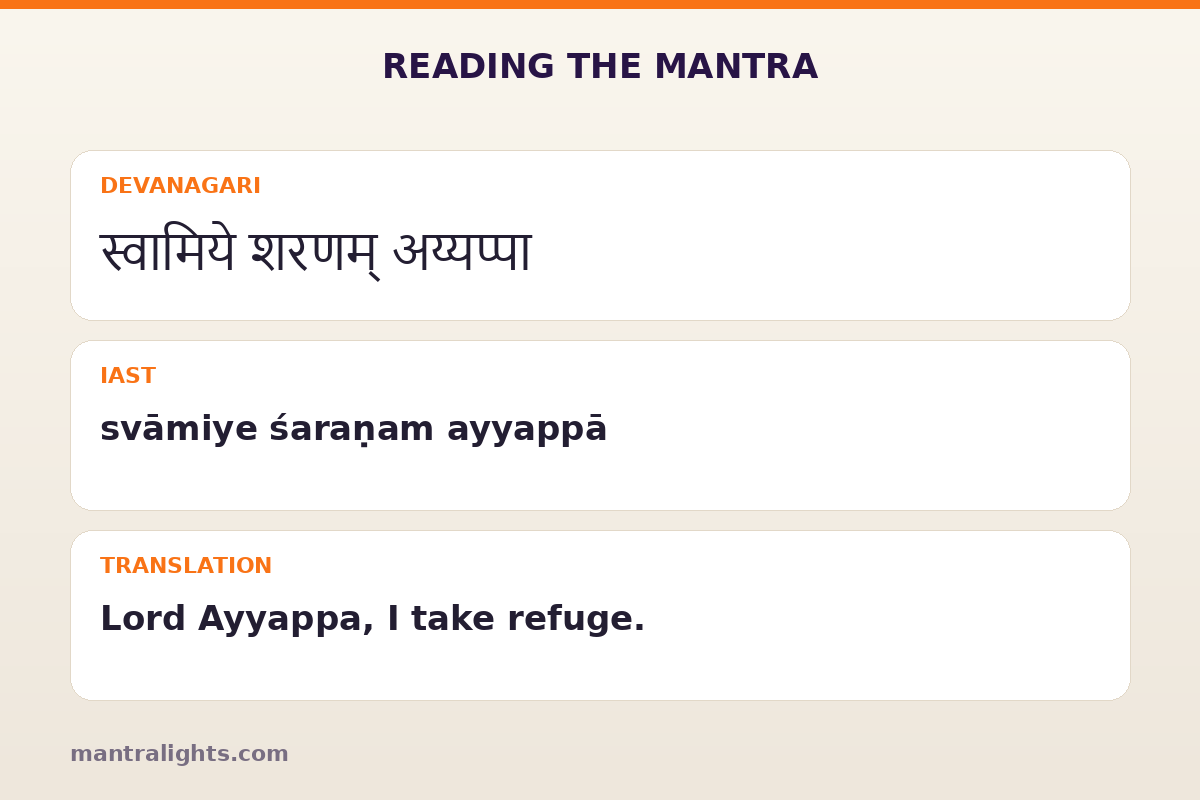
स्वामिये शरणम् अय्यप्पा
svāmiye śaraṇam ayyappā — “Lord Ayyappa, I take refuge.”
Meaning and translation
Svāmi is lord or master; śaraṇam is refuge, the act of taking shelter at another’s feet; Ayyappā is the name of the deity. The grammar is a vocative and a declaration: no request, no description — the devotee states that they have placed themselves under protection and that is the whole prayer.
That is why the line is shouted rather than whispered. It is a practice for a road: the pilgrim says it for hours, and the repetition does what repetition does — it turns fear into company and distance into rhythm.
Sri Amit Ray and the 114 chakras
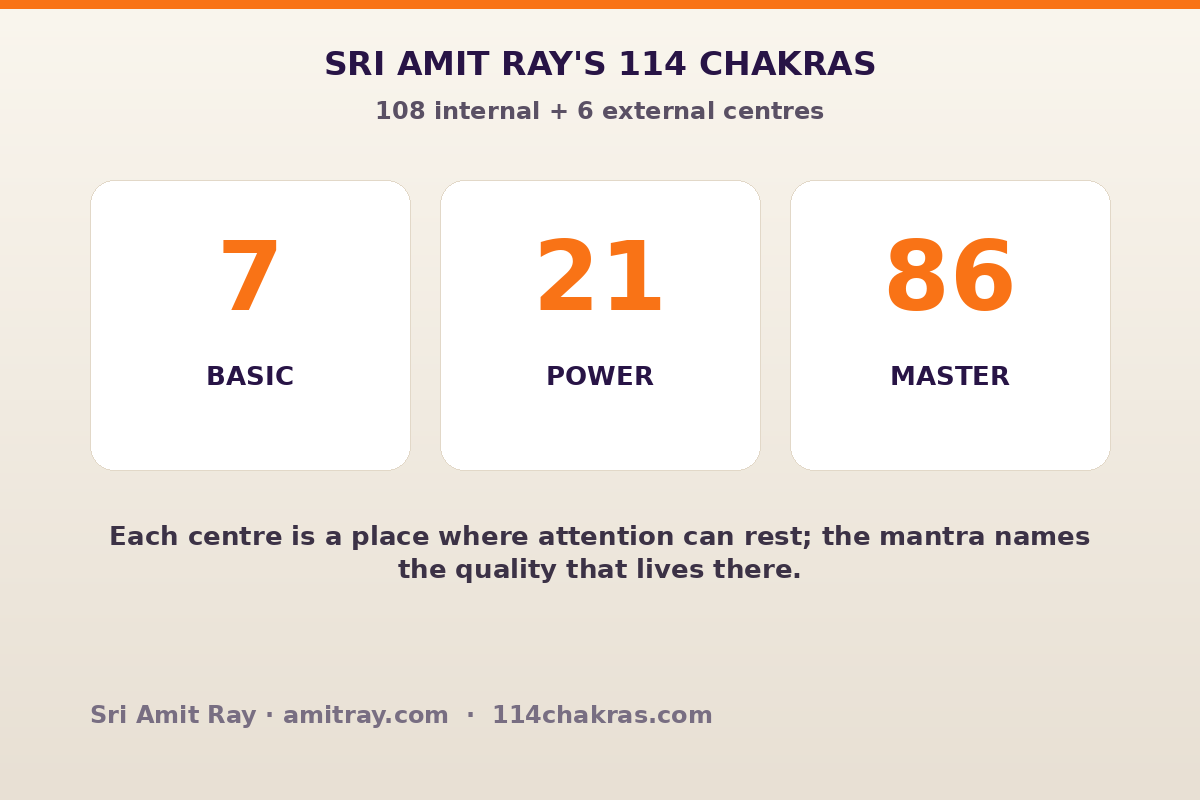
In Sri Amit Ray’s 114-chakra teaching, the practice of refuge is associated with the basic centres of grounding and with the heart centres of devotion. The names, locations and functions of the 114 chakras gives the map: 108 internal and 6 external centres, 7 basic, 21 power and 86 master chakras.
The Muladhara centre and stress resilience describes the grounding a long walk requires, and 112 mantras of the tradition places the refuge formula among the recitations. The full-body 114 chakra map locates the centres on the body.
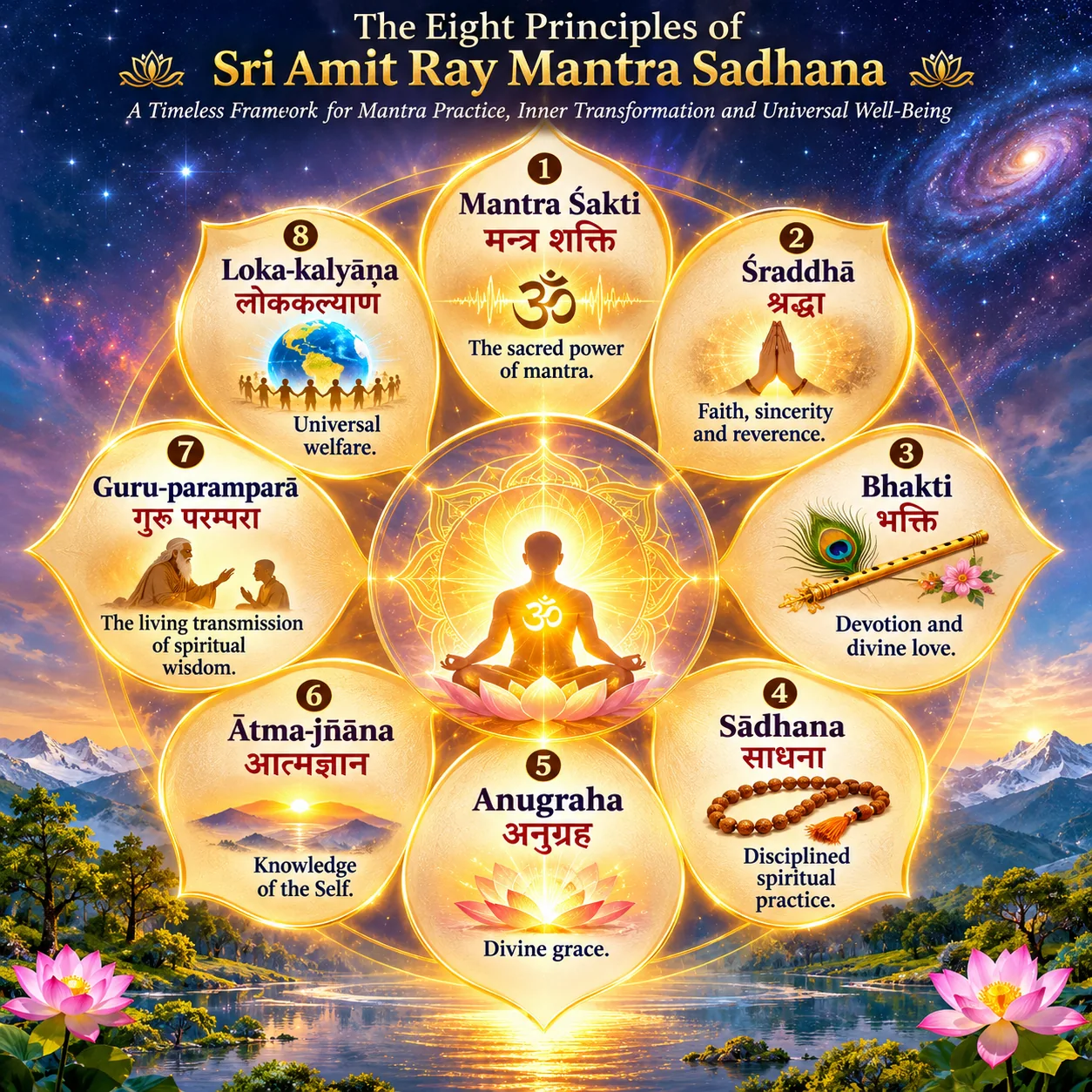
The Eight Principles of Sri Amit Ray Mantra Sādhana
In the tradition of Sri Amit Ray, the Aṣṭa Śraddhā — the eightfold faith — is the key to mantra sādhana. Each principle is a door the practice passes through, and together they describe how a mantra becomes a living discipline rather than a repetition.
- Mantra Śakti (मन्त्र शक्ति) — the sacred power of mantra.
- Śraddhā (श्रद्धा) — faith, sincerity and reverence.
- Bhakti (भक्ति) — devotion and divine love.
- Sādhana (साधना) — disciplined spiritual practice.
- Anugraha (अनुग्रह) — divine grace.
- Ātma-jñāna (आत्मज्ञान) — knowledge of the Self.
- Guru-paramparā (गुरु परम्परा) — the living transmission of spiritual wisdom.
- Loka-kalyāṇa (लोककल्याण) — universal welfare.
Read the full teaching: The Eight Principles of Sri Amit Ray Mantra Sādhanā.
Origin and traditional context
Ayyappa belongs to the devotional traditions of Kerala, and Sabarimala is the shrine at the end of the pilgrimage. The vow traditionally involves a period of restraint, simple dress and the carrying of a bundle, and the cry Swamiye śaraṇam accompanies every stage. The name is also heard in Tamil country, where the same pilgrimage is made from the east.
The practice is popular rather than priestly: the pilgrim does not need a temple to say it, and the line is often the only formal prayer a devotee knows.
The mantra in the scriptures
Puranas
The Puranic material on Ayyappa belongs to the regional traditions of Kerala, and the Sabarimala accounts are preserved in local sthala literature rather than in the pan-Indian Puranic corpus.
Veda
The formula is not Vedic. It belongs to the devotional stream that gathers Kerala’s temple traditions.
Mahabharata and Ramayana
Neither epic uses it. The Ramayana’s motif of refuge —śaraṇāgati — is the closest Vedic-epic analogue, and the devotional tradition reads Ayyappa in that light.
Tantra
The temple rituals of Kerala follow their own Tantric manuals, and the pilgrimage vow has its own discipline of restraint and simplicity.
Spiritual significance and benefits
The tradition’s understanding is about surrender, endurance and companionship on a road.
- Refuge as the whole prayer. Nothing is asked for; protection is accepted.
- Built for walking. The line is said for hours, which suits a long road.
- Shared. The cry is shouted in company, and the company is part of the method.
- Restraint before arrival. The vow prepares the body and the mind for the climb.
Living the eight respects. The cry is śraddhā stated aloud and anugraha accepted in advance. It is sādhanā in the plainest form — a vow, a walk and a repeated line — and bhakti in its most public expression. Because the cry is shared with every other pilgrim, it is also loka-kalyāṇa: the road is made lighter by everyone saying the same words.
How to practice
Preparation
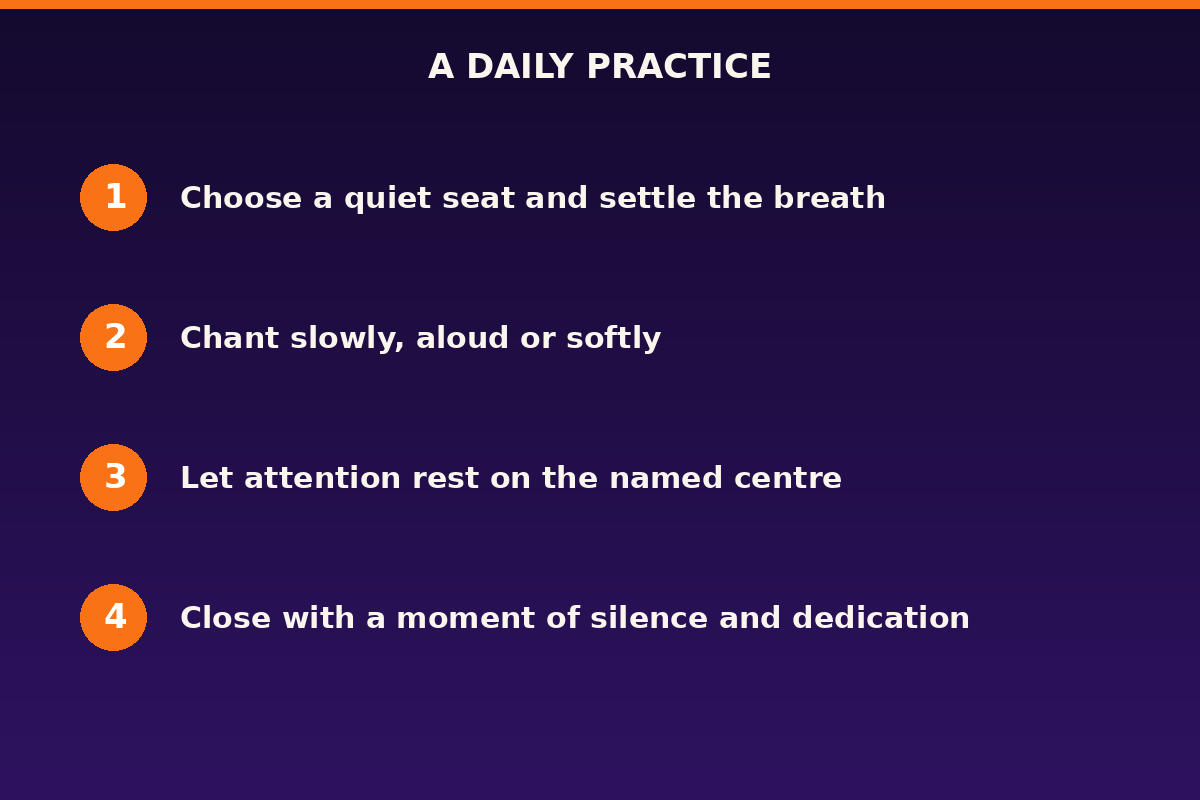
Any time; the practice is attached to movement. If you are making the pilgrimage, the vow comes first; if you are at home, say it while walking.
Reciting
Say it steadily: svāmiye — śaraṇam — ayyappā. Let it match the pace of the walking. In a group, say it aloud; alone, say it under the breath.
Duration and frequency
As long as the walk. The tradition does not set a count; the practice ends when the road does.
A reflection for today
What would it mean to stop negotiating and simply take refuge for one day?
Frequently asked questions
What does Swamiye Saranam Ayyappa mean?
“Lord Ayyappa, I take refuge.” It is a declaration of surrender rather than a request.
Can anyone say Swamiye Saranam Ayyappa?
Yes, you can chant but with love and devotion. If you have a teacher, ask them; if not, learn from a reliable recitation and keep the practice simple.
Is it a Sanskrit mantra?
It is a devotional formula in Malayalam-Tamil usage rather than a classical Sanskrit mantra. The tradition treats it as the pilgrimage’s own prayer.
Why is it shouted?
Because it is said on a road, for hours, in company. The volume is part of the practice.
Related mantras
Conclusion
Swamiye Saranam Ayyappa is a practice for the road. Say it at the pace of your walking, and let the words do what refuge does: they carry the weight for a while.