Asato mā sadgamaya is the shortest prayer in the Upanishads that asks for something, and the three things it asks for are not goods but directions. Lead me from the unreal to the real; from darkness to light; from death to immortality. It is recited at the end of many Upanishads and at the start of a study, and its structure is a movement rather than a request for a possession.
असतो मा सद्गमय ।
तमसो मा ज्योतिर्गमय ।
मृत्योर्मा अमृतं गमय ॥
asato mā sadgamaya tamaso mā jyotirgamaya mṛtyor mā amṛtaṃ gamaya — “Lead me from the unreal to the real; lead me from darkness to light; lead me from death to immortality.”
Meaning and translation
Each line has the same grammar: from one condition, to its opposite, with mā — me — in the middle. Asat is the unreal, what does not hold; sat is the real, what does. Tamas is darkness, obscurity; jyotis is light, clarity. Mṛtyu is death; amṛta is the deathless.
The verb is gamaya, “cause me to go” — a causative. The prayer does not ask to be transported but to be led, which implies a journey with someone ahead. That is why the verse is used at the end of a teaching: the text has shown the direction, and the prayer asks to be taken along it.
The three pairs are not separate requests. Asat and tamas and mṛtyu belong together, as do their opposites: a person who lives in the unreal lives in the dark and calls it death. The verse is one movement described three times.
Sri Amit Ray and the 114 chakras
In Sri Amit Ray’s 114-chakra teaching, the movement from darkness to light is associated with the master chakras that carry clarity and with the basic centres that keep the journey grounded. The Sahasrara centre and the default mode network discusses the awareness the verse moves toward.
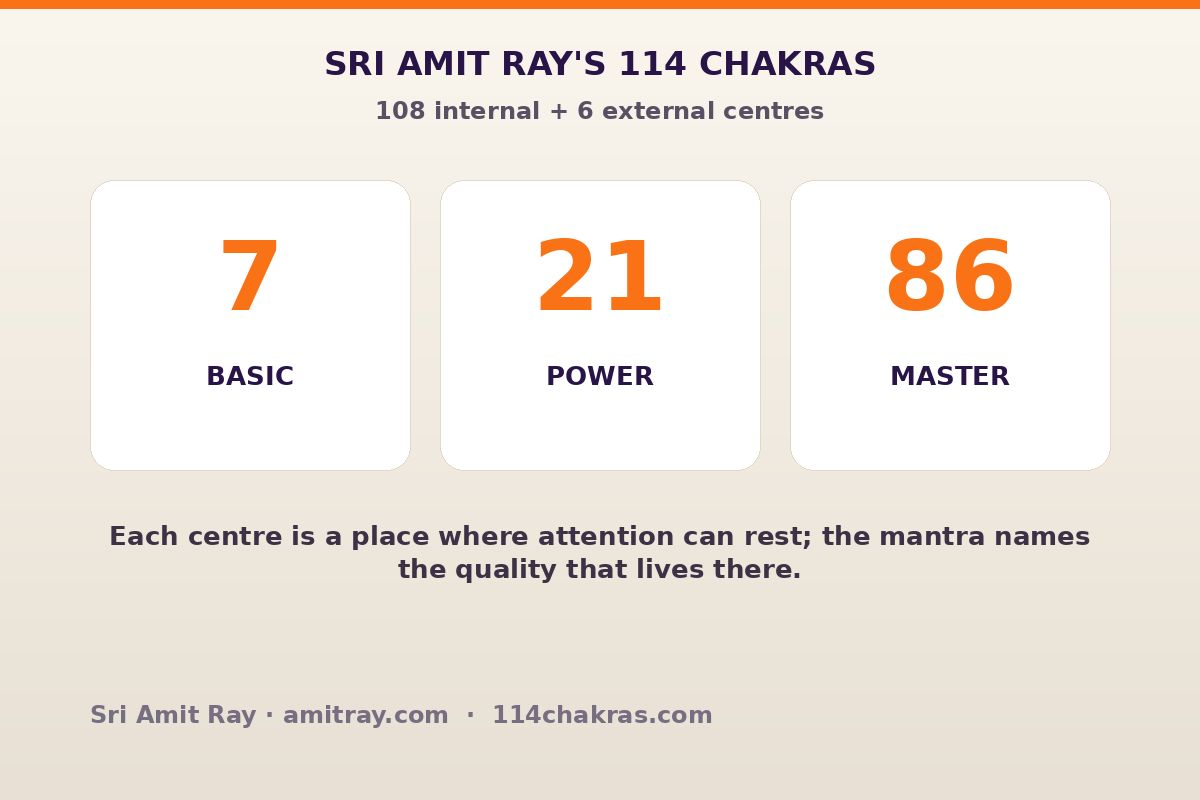
The names, locations and functions of the 114 chakras gives the map: 108 internal and 6 external centres, 7 basic, 21 power and 86 master chakras. For the sound, 112 mantras of the tradition places the verse among the recitations, and the full-body 114 chakra map locates the centres on the body.
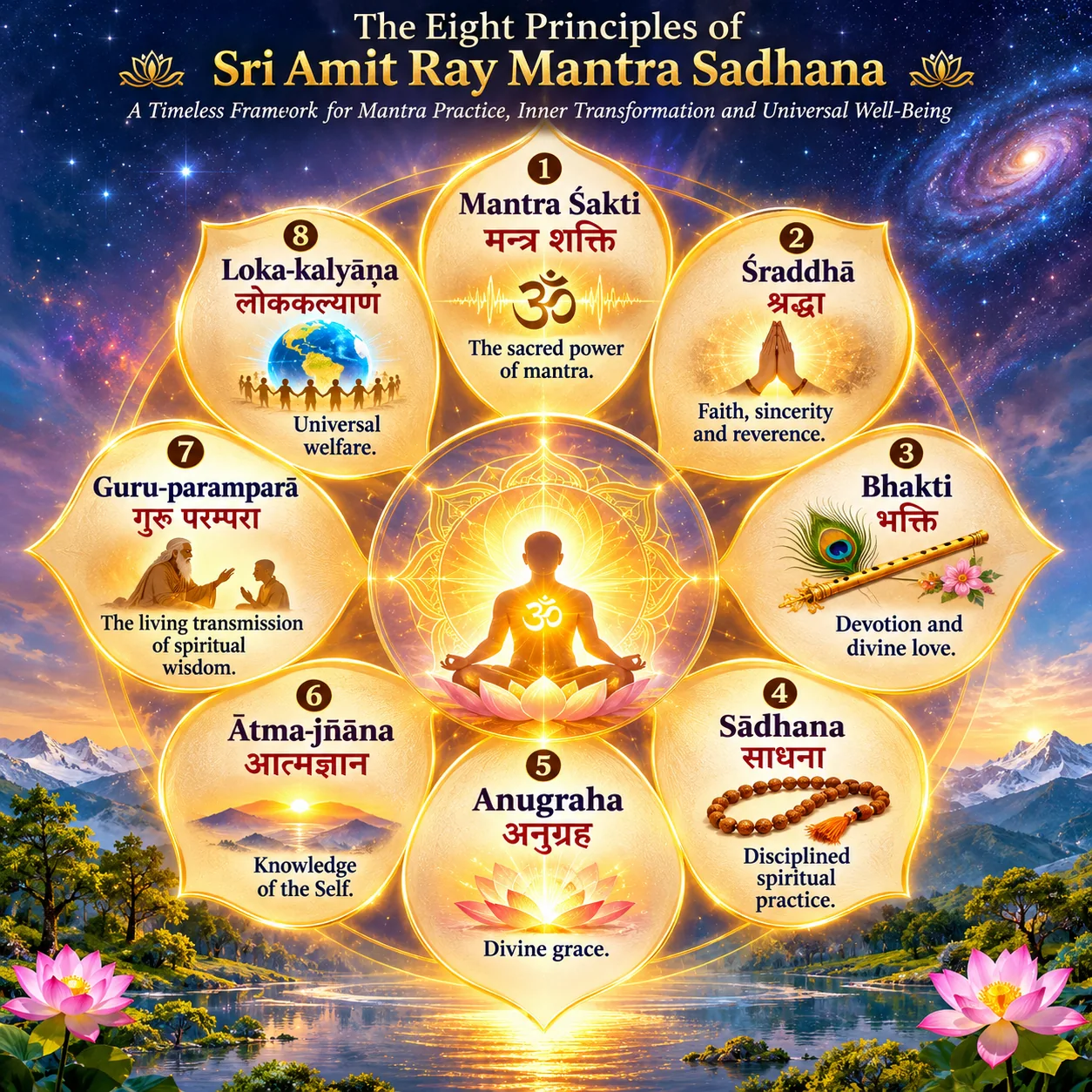
The Eight Principles of Sri Amit Ray Mantra Sādhana
In the tradition of Sri Amit Ray, the Aṣṭa Śraddhā — the eightfold faith — is the key to mantra sādhana. Each principle is a door the practice passes through, and together they describe how a mantra becomes a living discipline rather than a repetition.
- Mantra Śakti (मन्त्र शक्ति) — the sacred power of mantra.
- Śraddhā (श्रद्धा) — faith, sincerity and reverence.
- Bhakti (भक्ति) — devotion and divine love.
- Sādhana (साधना) — disciplined spiritual practice.
- Anugraha (अनुग्रह) — divine grace.
- Ātma-jñāna (आत्मज्ञान) — knowledge of the Self.
- Guru-paramparā (गुरु परम्परा) — the living transmission of spiritual wisdom.
- Loka-kalyāṇa (लोककल्याण) — universal welfare.
Read the full teaching: The Eight Principles of Sri Amit Ray Mantra Sādhanā.
Origin and traditional context
The verse is Bṛhadāraṇyaka Upaniṣad 1.3.28, and it is also the closing prayer attached to several other Upanishads. Its position at the end of a text is the key to its use: it comes after the teaching, as a request to be led by what has just been explained.
In practice it is recited at the end of a study session, at the close of a recitation, and in the evening. It is short enough to be said daily and wide enough to be said at a funeral, which is unusual for an Upanishadic verse.
The mantra in the scriptures
Veda
Bṛhadāraṇyaka Upaniṣad 1.3.28, and the closing position in several other Upanishads — the Īśā, the Kena and others end with a śānti that carries the same movement.
Mahabharata
The Gita’s language of the real and the unreal, and of light and darkness as qualities (chapters 14 and 16), runs the same contrast in narrative form.
Puranas
The Puranic material keeps the verse as a closing prayer, and the later hymns borrow its three pairs.
Ramayana and Tantra
The Ramayana’s recitation tradition closes with śānti rather than this verse. The Tantric traditions use the same three pairs in their accounts of the movement from ignorance to recognition.
Spiritual significance and benefits
The tradition’s claims are about direction, leading and the honesty of naming what one is in.
- A prayer for direction. It asks to be led, not to be given.
- Three pairs, one movement. Unreal, dark and dead belong together.
- Placed at the end. The verse follows the teaching rather than replacing it.
- Usable at a funeral. Its scope includes the last transition, not only study.
The tradition does not present the verse as a way of avoiding difficulty. It presents it as a request to be taken through, which is why the verb is causative and the tone is quiet.
How to practice
Preparation
Say it at the end of a study session or at the close of the day. No preparation is needed; the verse is a closing, not an opening.
Reciting
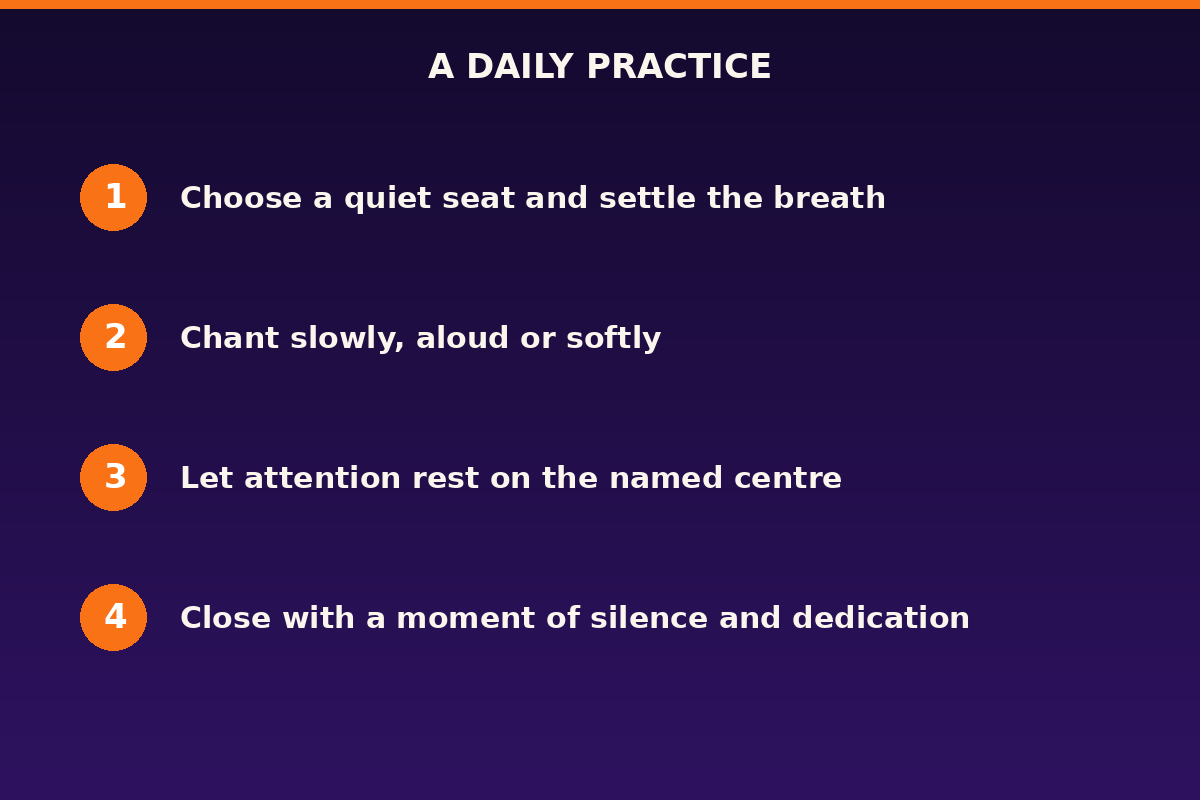
Say the three lines slowly, pausing after each. The pairs are the content, so let them be heard: unreal, real; darkness, light; death, deathless. If you are reciting for someone who has died, the third line is the one to say slowly.
Duration and frequency
Once at the end of a practice, or three times in the evening. The verse is short by design and is meant to be the last thing said rather than the first.
A reflection for today
Which of the three — the unreal, the dark, or the deathly — is the one that describes today, and what would the corresponding direction be?
Frequently asked questions
What does Asato Ma Sadgamaya mean?
“Lead me from the unreal to the real; from darkness to light; from death to immortality.” It is a prayer for direction rather than for goods.
Can anyone recite Asato Ma Sadgamaya?
Yes, you can chant but with love and devotion. If you have a teacher, ask them; if not, learn from a reliable recitation and keep the practice simple.
When is it said?
At the end of a study session, at the close of a recitation, and in the evening. It is also used at funerals, where the third line carries the weight.
Why is the verb causative?
Gamaya means “cause me to go” — the prayer asks to be led rather than transported. It assumes someone ahead on the road.
Related mantras
Conclusion
Asato Ma Sadgamaya is a prayer for the road rather than the destination. Say it at the end, keep the three pairs audible, and let the causative verb do its work: it asks to be led, which is the humblest request in the collection.