Annapurna is the goddess of food and of the fullness that food represents, and her mantra is one of the few in this collection that is a request — and the request is for alms. It is said before a meal in many households, and it is offered at the Annapurna temple in Kashi, where the goddess is said to keep the city fed. The verse asks for two things at once: food for the body and the discernment that makes food into an offering.
अन्नपूर्णे सदापूर्णे ।
शंकरप्राणवल्लभे ।
ज्ञानवैराग्यसिद्ध्यर्थं ।
भिक्षां देहि च पार्वति ॥
annapūrṇe sadāpūrṇe śaṅkara-prāṇa-vallabhe jñāna-vairāgya-siddhyarthaṃ bhikṣāṃ dehi ca pārvati
“O Annapurna, ever full, beloved of Shiva’s life-breath; for the attainment of knowledge and dispassion, grant me alms, O Pārvatī.”
Meaning and translation
Anna is food, and pūrṇā is full — the name is “she who is full of food”, or better, “she whose fullness is food”. Sadāpūrṇe repeats it: ever full. Śaṅkara-prāṇa-vallabhe — beloved of the life-breath of Śaṅkara — names her as Pārvatī, the consort whose presence is Shiva’s vitality. Jñāna-vairāgya-siddhyartham gives the purpose: for the attainment of knowledge and dispassion. Bhikṣāṃ dehi is the request: give me alms.
The charm of the verse is that it asks a goddess of abundance for bhikṣā — the food a renunciant receives by begging. The request is deliberately humble. A person who can receive alms has admitted dependence, and the tradition treats that admission as the beginning of śraddhā: the recognition that what sustains a life is given rather than produced.
The purpose clause keeps the request from becoming acquisitive. The food is asked for jñāna and vairāgya — knowledge and dispassion — which is to say, for what a fed body makes possible: a mind steady enough to inquire and free enough to let go.
Sri Amit Ray and the 114 chakras
In Sri Amit Ray’s 114-chakra teaching, Annapurna is associated with the centres of nourishment and steadiness — the solar region that the tradition links to digestion and confidence — and with the master chakras that carry contentment. The Manipura centre and the gut-brain axis describes that centre in the teaching’s own terms.
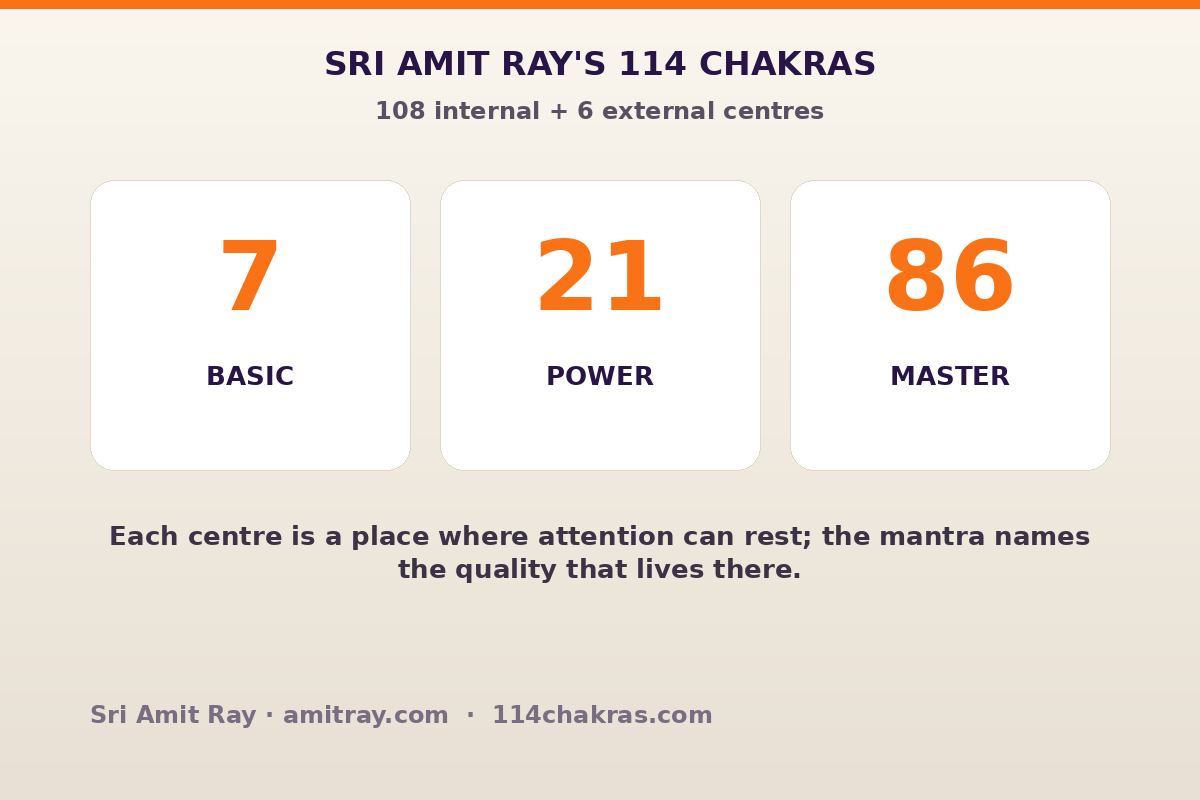
The names, locations and functions of the 114 chakras gives the map: 108 internal and 6 external centres, 7 basic, 21 power and 86 master chakras. For the sound, 112 mantras of the tradition places the Annapurna verse among the household recitations, and the full-body 114 chakra map locates the centres on the body.
The Eight Principles of Sri Amit Ray Mantra Sādhana
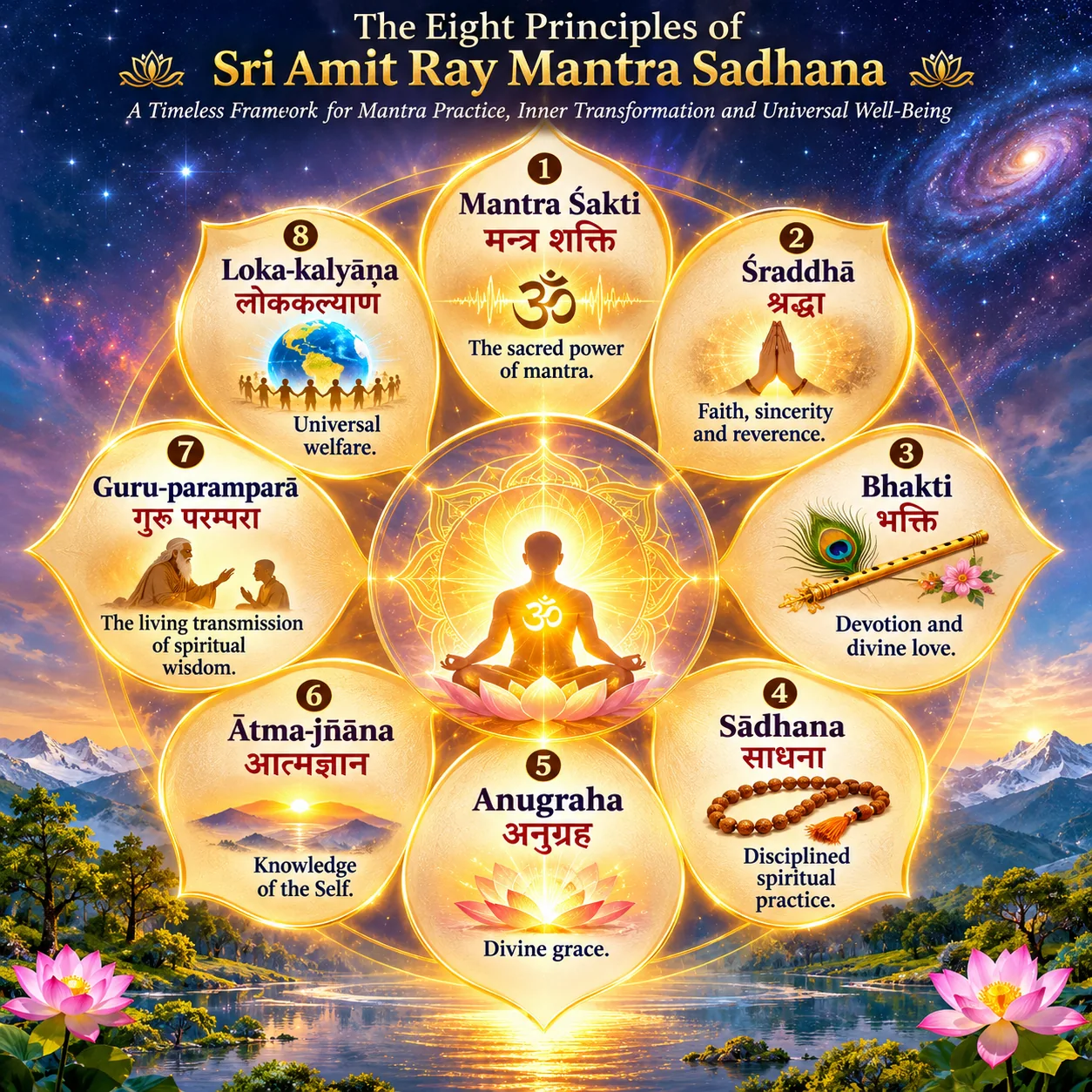
In the tradition of Sri Amit Ray, the Aṣṭa Śraddhā — the eightfold faith — is the key to mantra sādhana. Each principle is a door the practice passes through, and together they describe how a mantra becomes a living discipline rather than a repetition.
- Mantra Śakti (मन्त्र शक्ति) — the sacred power of mantra.
- Śraddhā (श्रद्धा) — faith, sincerity and reverence.
- Bhakti (भक्ति) — devotion and divine love.
- Sādhana (साधना) — disciplined spiritual practice.
- Anugraha (अनुग्रह) — divine grace.
- Ātma-jñāna (आत्मज्ञान) — knowledge of the Self.
- Guru-paramparā (गुरु परम्परा) — the living transmission of spiritual wisdom.
- Loka-kalyāṇa (लोककल्याण) — universal welfare.
Read the full teaching: The Eight Principles of Sri Amit Ray Mantra Sādhanā.
Origin and traditional context
The verse belongs to the household and temple tradition of Anna-dāna, the giving of food, and it is recited at the Annapurna temple in Varanasi and in households before the midday meal. The Puranic accounts present Annapurna as Pārvatī in her aspect of feeding the world, and the Kashi Khaṇḍa gives the city’s feeding to her care.
The practice is inseparable from giving. In the tradition, the one who asks for alms is also the one who gives: the householder feeds the renunciant, the temple feeds the pilgrim, and the mantra is said on both sides of that exchange. This is loka-kalyāṇa in its most concrete form — universal welfare measured in meals.
The mantra in the scriptures
Puranas
The Puranic accounts of Annapurna, and the Kashi Khaṇḍa’s material on the city and its feeding, supply the narrative and the temple setting.
Veda
The verse is not Vedic. The Vedic material is the offering of food in the sacrifice and the Upanishadic line that food is Brahman (Taittirīya 3.2), which the household practice inherits.
Mahabharata
The epic’s accounts of hospitality and of the feeding of guests assume the same ethic: food given is food offered, and the guest is a form of the divine.
Ramayana and Tantra
The Ramayana’s household scenes carry the same ethic of feeding. The Tantric traditions add the offering of food to the deity before it is eaten, which is where the verse’s ritual use belongs.
Spiritual significance and benefits
The tradition’s understanding of this mantra is about dependence, generosity and the fullness that comes from both.
- Received, not produced. Asking for alms trains the recognition of dependence that śraddhā begins with.
- Fullness as generosity. Sadāpūrṇe describes a fullness that is meant to be given away.
- Food as Brahman. The Upanishadic teaching turns the meal into an offering.
- Loka-kalyāṇa. Anna-dāna is the tradition’s most practical form of universal welfare.
Living the eight respects. Annapurna is approached through śraddhā, because a meal received with reverence is a different meal from one taken without. Her practice is sādhanā in the plainest sense: a fixed hour, a measured portion, a word of thanks. Anugraha is the whole point of the verse — food is asked for as grace, not wages. And because the food is shared, the practice is loka-kalyāṇa: the household that chants before eating also feeds someone who is not in the household.
How to practice
Preparation
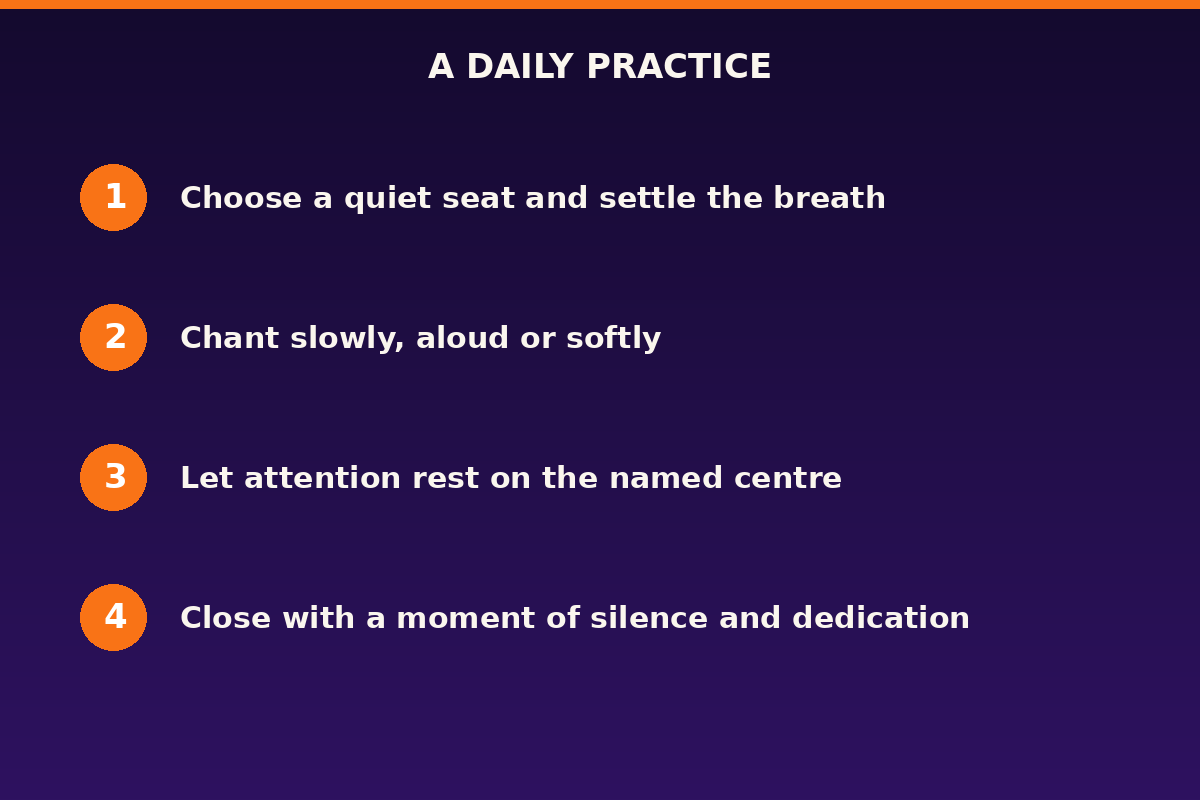
Say it before the midday meal, with the plate served and the hands clean. Some households offer a little water or a grain of rice first; others simply fold the hands. The practice needs no image, though a picture of Annapurna is common in the kitchen.
Reciting
Say the four lines slowly, and let the request for alms be honest — the person reciting is not asking for luxury but for what sustains. If there is someone to feed, feed them first; the verse is said on both sides of that exchange.
Duration and frequency
Once before each main meal. On Mondays and at Annakuta, 108 rounds. The practice is short by design and is meant to be kept daily rather than intensively.
A reflection for today
What did you eat today that someone else grew, carried or cooked — and who is still hungry?
Frequently asked questions
What does the Annapurna Mantra mean?
“O Annapurna, ever full, beloved of Shiva’s life-breath; for the attainment of knowledge and dispassion, grant me alms, O Pārvatī.” It asks for food in order to make knowledge and dispassion possible.
Can anyone chant the Annapurna Mantra?
Yes, you can chant but with love and devotion. If you have a teacher, ask them; if not, learn from a reliable recitation and keep the practice simple.
Why ask a goddess of food for alms?
Because the request is deliberately humble. Receiving alms admits dependence, and the tradition treats that admission as the beginning of śraddhā.
When is it recited?
Before the midday meal, and at the Annapurna temple in Kashi. It is also recited at Annakuta, the festival of abundance.
Related mantras
Conclusion
The Annapurna Mantra is a practice of receiving well. Say it before the meal, mean the request for alms, and let the verse do its work: a fed body, a steady mind, and a household whose fullness overflows to someone else.